
Why Your Dental CBCT Report Mentions Sinuses and Jaw Joints
A dental CBCT captures more than implant sites. Learn why sinus and jaw-joint findings appear and which clinician can evaluate them.
Have your own scan or report? Get a clear, plain-language explanation in minutes.
A scan ordered for teeth can show much more than teeth
A cone-beam computed tomography scan, usually called a dental CBCT, creates detailed three-dimensional images of the teeth and facial bones. A dentist may order one before placing an implant to measure the height, width, and shape of bone at a specific tooth site.
However, the X-ray beam does not stop at that site. Depending on the scan’s field of view, it may also capture the nasal cavity, maxillary sinuses, airway, and temporomandibular joints, or TMJs. The report may therefore mention findings that have little to do with the planned implant.
This can create an unexpected referral loop: the dentist ordered the scan but may not be the right clinician to evaluate sinus disease or manage a jaw-joint disorder. Understanding what the report means—and what it does not mean—can make the next step less confusing.
Why the maxillary sinuses appear on dental CBCT
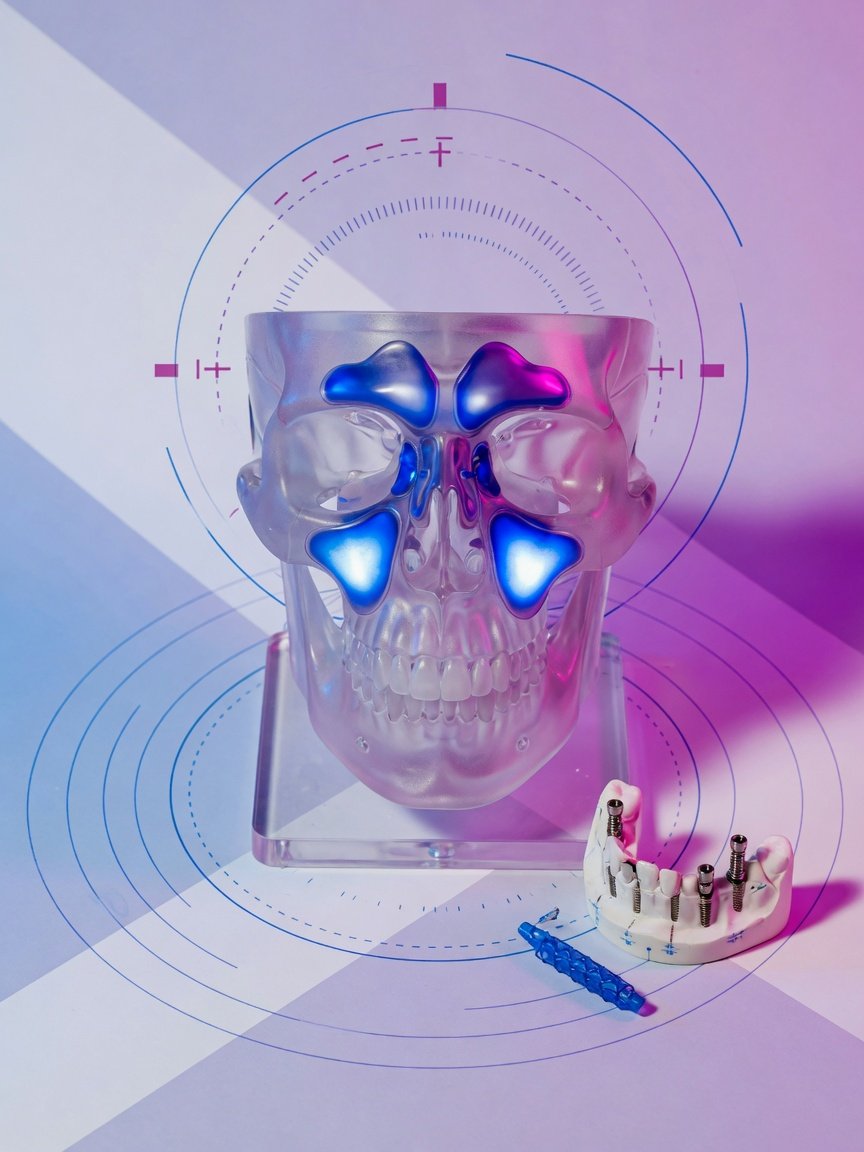
The maxillary sinuses are air-filled spaces inside the cheekbones. Their floors sit close to the roots of the upper back teeth. In some people, only a thin layer of bone separates a tooth socket from the sinus.
This relationship matters during implant planning. The dentist needs to know how much bone is available and whether an implant could approach the sinus floor. A larger field of view may capture most or all of both maxillary sinuses, even if the implant is planned for only one area.
What does sinus mucosal thickening mean?
The inside of each sinus has a thin soft-tissue lining called mucosa. On CBCT, that lining may look thicker than expected. A report might describe this as mucosal thickening, inflammatory change, or a finding consistent with sinus inflammation.
Mucosal thickening is common and nonspecific. It can be associated with a recent cold, allergies, chronic sinus irritation, or an infection. Dental problems can also inflame a nearby sinus, particularly when an upper tooth has a deep infection or disease around its root.
The image alone usually cannot establish the exact cause. CBCT is excellent for showing teeth and bone, but it provides less soft-tissue detail than a medical CT or MRI. The significance depends on the pattern, extent, nearby dental findings, and symptoms.
When a sinus finding may deserve more attention
- Symptoms match the scan: ongoing facial pressure, blocked breathing through the nose, reduced sense of smell, or persistent drainage may support further medical evaluation.
- The change is mainly on one side: one-sided sinus disease can have dental or non-dental causes that may need clarification.
- A nearby tooth looks infected: treating the dental source may be an important part of addressing sinus inflammation.
- Implant surgery could involve the sinus: active or significant sinus disease may affect surgical planning, especially if a sinus lift is being considered.
A primary care clinician can assess general sinus symptoms. An ear, nose, and throat specialist, or ENT, may be appropriate for persistent, recurrent, severe, or one-sided problems. A dentist or endodontist evaluates whether a tooth is contributing.
Why the jaw joints appear on the same scan
The TMJs sit just in front of the ears, where the rounded ends of the lower jaw—called the condyles—meet the skull. A medium or large dental CBCT field may include one or both joints.
A report may describe flattening, sclerosis, irregularity, or a small beak-shaped bony outgrowth. Such an outgrowth may be called an osteophyte and can be interpreted as possible degenerative remodeling.
The word degenerative often sounds alarming, but an imaging change does not automatically mean there is a painful or progressive joint disorder. Bone can remodel in response to age, past stress, injury, clenching, grinding, or altered joint loading. Some people have visible changes without symptoms.
Clinical correlation means the scan finding should be compared with symptoms and a physical examination. It does not mean that a diagnosis has already been confirmed.
Symptoms that help put TMJ findings in context
- Pain in front of the ear or in the jaw muscles
- Jaw stiffness or limited opening
- Pain with chewing
- Locking or catching of the jaw
- A recent change in the bite
- Joint sounds accompanied by pain or loss of function
Clicking or popping by itself is not always a sign of harmful disease. CBCT also shows bone better than it shows the joint’s soft-tissue disc, so it cannot answer every question about TMJ symptoms.
A general dentist may perform an initial examination. Persistent or complex symptoms may be evaluated by a dentist trained in orofacial pain, an oral and maxillofacial surgeon, or another clinician with specific TMJ expertise. Referral does not necessarily mean surgery is expected.
Who is responsible for an incidental finding?
The ordering dentist is responsible for reviewing the report and explaining how it affects dental care. However, professional scope matters. A dentist may recognize a sinus abnormality without being equipped to diagnose or treat chronic sinus disease. Likewise, an ENT treats sinus conditions but does not usually determine whether a tooth needs root canal treatment or whether an implant site has enough bone.
This is why several clinicians may become involved:
- Implant dentist, periodontist, or oral surgeon: implant position, available bone, sinus proximity, and surgical planning
- General dentist or endodontist: tooth decay, root infection, or other possible dental sources of sinus inflammation
- Primary care clinician or ENT: sinus symptoms and non-dental causes of sinus disease
- Orofacial pain dentist or oral and maxillofacial surgeon: symptomatic or structurally concerning TMJ findings
Bringing the written report and access to the original CBCT images can reduce duplicated testing. The key question is not simply whether an abnormal phrase appears in the report, but whether it changes treatment, matches symptoms, or needs another type of examination.
When to talk to your doctor
Discuss the report with the ordering dentist and ask whether it affects the planned dental procedure. Medical evaluation is generally appropriate for persistent or worsening sinus symptoms, significant one-sided symptoms, jaw pain, locking, reduced opening, or a changing bite. Urgent care may be needed for facial swelling with fever, swelling around an eye, vision changes, severe headache, confusion, or rapidly worsening symptoms.
This article provides general education and is not a diagnosis or a substitute for evaluation by a qualified dental or medical professional.

Get AI-powered analysis of your CT or MRI scan
Upload your DICOM files and receive a clear, patient-friendly report in minutes.
Analyze my scan