
Injury or Wear and Tear: Can a Scan Tell What Caused It?
Can MRI tell whether a fall, crash, or heavy lift caused an abnormality? Learn what scans can reveal—and why timing and earlier images matter.

Have your own scan or report? Get a clear, plain-language explanation in minutes.
Your pain started after a car accident, a fall, or a heavy lift. Then the scan report mentions “degenerative changes,” a disc bulge, or changes from earlier shoulder surgery. It is natural to ask: Was this already there, or did the incident cause it?
A scan can offer clues, but it usually cannot answer that question on its own. An abnormality’s appearance, its likely age, and its cause are three different things. This article provides general education, not a diagnosis or an assessment of any individual injury.
What a scan shows—and what it cannot prove
MRI, CT, and X-rays show different aspects of bones and soft tissues. They can identify findings such as a fracture, a disc protrusion, tendon damage, or swelling. But they are not recordings of what happened during an accident.
When interpreting a finding, clinicians consider three separate questions:
- Appearance: What does the tissue look like? Is there a break, bulge, tear, or swelling?
- Likely age: Are there features suggesting a recent injury, a longstanding change, or a mixture?
- Causation: Does the finding fit the reported event, symptom timeline, examination, and earlier records?
A finding can look longstanding while symptoms are new. A finding can also look recent without revealing exactly which event caused it. MRI alone cannot reliably assign accident responsibility or provide a definitive injury date.
Does “degenerative” mean fresh—or unrelated to the accident?
“Degenerative” generally describes changes that develop over time, such as reduced water content in a disc, bone spurs, or gradual tendon changes. It does not mean “fresh injury.” It also does not automatically mean that a recent incident had no effect.
Several situations are possible after an accident or heavy lift:
- A pre-existing abnormality is discovered but is unrelated to the pain.
- A previously painless condition becomes symptomatic.
- A new injury occurs alongside older changes.
- Pain comes from a strain or another problem that is not clearly visible on the scan.
These possibilities can overlap. The word “degenerative” alone cannot distinguish between them, and it does not mean the pain is imaginary or unimportant.
Which findings may suggest a recent injury?
A fracture line, disrupted ligament, surrounding soft-tissue swelling, or bone marrow edema may support a recent injury in the right setting. Bone marrow edema means increased fluid within the bone, often described informally as a bone bruise or bone reaction.
However, swelling is a clue, not a date stamp. It can occur with trauma, repeated loading, arthritis, surgery, and other conditions. It may persist during healing, and its appearance does not establish an exact injury date.
Likewise, a scan showing no clear fresh injury can be reassuring about certain serious problems without excluding every strain, subtle ligament injury, or source of pain. How well an injury can be seen depends on the body part, scan technique, timing, and image quality.
Common questions after an accident or heavy lift
“Did my fall or car accident cause this disc bulge?”
A disc bulge or protrusion may have been present before symptoms started. Disc shape alone often cannot establish whether a finding appeared during a particular accident.
For example, small spinal disc protrusions without a fracture, nearby bone swelling, or clear ligament disruption may look more longstanding. That does not prove they were present before the crash, nor does it explain away new pain. Clinicians look for a match between the symptoms, examination, and the location of the finding.
“Can heavy lifting or a sudden pull cause a shoulder fracture?”
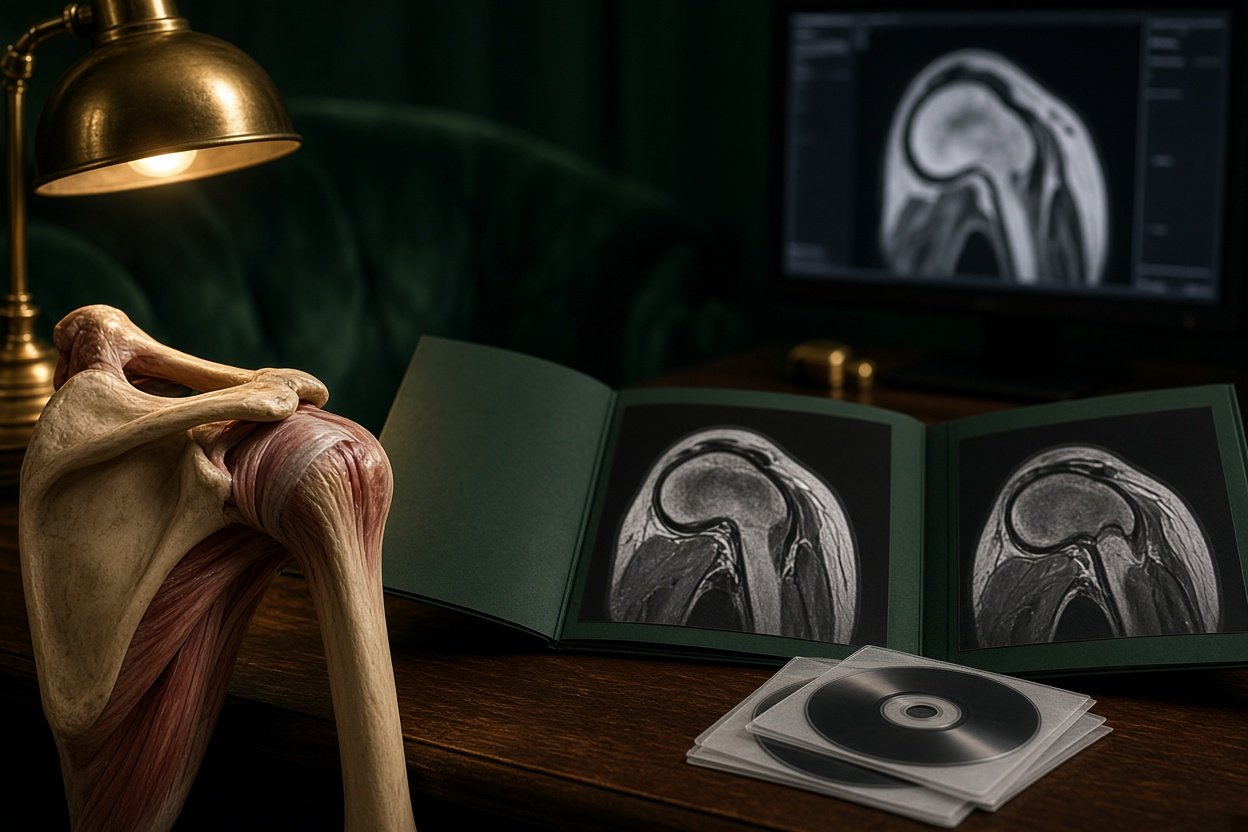
Shoulder pain after carrying something heavy can arise from a tendon injury, irritated bursa, muscle strain, or, less commonly, a bone injury. Repeated loading can sometimes cause a stress injury; a forceful tendon pull can also injure bone at its attachment.
Bone marrow edema near a tendon attachment does not, by itself, prove a fracture or its cause. If a fracture is suspected but not clearly established, review of all MRI sequences—and sometimes X-rays or CT—may help clarify the finding.
“I had rotator cuff surgery. Is this a new tear?”
A repaired tendon may remain thickened or have an altered appearance on MRI. Scar tissue and surgical anchors can also change the images; some materials create distortion that hides nearby detail.
These postoperative appearances do not automatically indicate a new tear. Conversely, earlier surgery does not rule one out. The operation report, time since surgery, earlier postoperative scans, and any new loss of strength or movement help put the findings in context. Suspected surgical material on a scan should be checked against the actual surgical history.
Why symptom timing and earlier scans matter
A clear timeline helps connect the images to the clinical story. Useful details include:
- Whether pain or limited movement existed before the event.
- Whether symptoms began immediately or developed later.
- The direction and force of the fall, collision, lift, or pull.
- Any new weakness, numbness, or change in daily function.
- Previous injuries, surgery, treatment, and recovery.
Earlier images can show that a finding was already present or that something has changed. But even a new finding between two scans does not necessarily prove that one specific event caused it: other changes may have occurred during that interval. Differences in scan technique can also affect what is visible.
The most useful question is often not “Can the MRI prove what happened?” but “Which findings fit the event and symptoms, and what remains uncertain?”
When to talk to your doctor
Discuss persistent or worsening pain, reduced movement, new weakness, or an unclear report with your clinician. Earlier images and operation records can help. A suspected fracture needs prompt assessment.
Seek urgent medical care for new or worsening limb weakness, difficulty walking, loss of bladder or bowel control, numbness around the groin, or a cold or pale hand after an injury.
Get AI-powered analysis of your CT or MRI scan
Upload your DICOM files and receive a clear, patient-friendly report in minutes.
Analyze my scan