
Vascular Compression Syndromes and Static Imaging
Static scans can look normal when vascular compression happens only with position, movement, or changes in blood flow.

Have your own scan or report? Get a clear, plain-language explanation in minutes.
Why a normal-looking scan can still leave questions
If you are being evaluated for thoracic outlet syndrome, internal jugular vein compression, May-Thurner syndrome, Nutcracker syndrome, SMA syndrome, pelvic congestion, or omohyoid-related compression, it can be confusing to read that your vessels are patent but that dynamic compression is not fully excluded.
In plain language, patent means open. A scan may show no clot, no complete blockage, and no obvious fixed narrowing while still not answering a different question: does a vessel get squeezed only in certain positions, during certain movements, or under certain pressure or flow conditions?
This article is general education, not a diagnosis. Your own results need to be interpreted with your official radiology report, symptoms, physical exam, prior procedures, and specialist review.
Clot, fixed blockage, and compression are not the same thing
Many vascular imaging reports focus first on urgent or structural problems, such as a blood clot, aneurysm, dissection, severe narrowing, or complete occlusion. These are important findings to look for.
A clot is material inside the vessel that can partially or fully block blood flow. A fixed blockage or fixed stenosis is present in the same place regardless of body position. A vascular compression syndrome is different: the vessel may be open at rest but narrowed when nearby bones, muscles, ligaments, organs, or other structures press on it.
A static image is like a still photograph. A dynamic compression problem may behave more like a short video: the important part happens during motion, posture, or pressure change.
What static imaging can and cannot show
CT, MRI, CTA, CTV, MRA, and MRV can be very useful. They can show anatomy, masses, clots, dilated veins, collateral veins, stents, coils, organs, bones, and many other clues. However, many standard scans are performed with the body in a neutral position, often lying flat.
That matters because some people have symptoms when an arm is raised, the head is turned, the neck is flexed, the shoulder is pulled back, or the abdomen is compressed after eating or during certain breathing patterns. If the scan is done when the vessel is not being squeezed, the report may correctly say that the vessel looks open on those images.
This is why reports may include language such as no definite fixed compression, no acute clot, or dynamic compression cannot be excluded. Those phrases are not necessarily contradictory. They describe the limits of what that particular study can prove.
Examples of dynamic vascular compression syndromes
Thoracic outlet syndrome
Thoracic outlet syndrome involves compression near the lower neck, collarbone, first rib, and upper chest. It may affect nerves, veins, arteries, or a combination. Vascular forms may be more apparent when the arm is raised or placed in a provoking position. A neutral MRA or CT may show open subclavian vessels but still not fully test the position that triggers symptoms.
Internal jugular vein and omohyoid-related compression
The internal jugular veins drain blood from the head and neck. In some people, narrowing may be related to head and neck position, nearby muscles, or structures such as the omohyoid muscle. A neutral CT or MRV may show the jugular veins are open, while a targeted ultrasound during swallowing, head turning, or symptom-provoking movement may provide different information.
May-Thurner syndrome
May-Thurner anatomy involves compression of the left common iliac vein, commonly where it passes near the right common iliac artery and spine. Some people have a stent placed for this. Follow-up ultrasound may describe an open stent, no clot, and phasic blood flow. That is reassuring for patency, but symptoms may still lead clinicians to review stent position, inflow and outflow, pelvic venous reflux, and other venous pathways.
Nutcracker syndrome
Nutcracker syndrome refers to compression of the left renal vein, often between the aorta and the superior mesenteric artery. Imaging review may look for the degree of narrowing, upstream vein enlargement, collateral veins, kidney findings, and symptoms such as flank pain or blood in the urine. A scan without dedicated measurements may not fully confirm or exclude it.
SMA syndrome
Superior mesenteric artery syndrome is different because it usually involves compression of the duodenum, a part of the small intestine, between the aorta and the superior mesenteric artery. Imaging may look for stomach or duodenal dilation and measure the angle and distance between these vessels. A routine scan may not include all needed measurements.
Pelvic congestion and pelvic venous disorders
Pelvic congestion can involve enlarged pelvic veins, ovarian or gonadal vein reflux, internal iliac vein pathways, and sometimes associations with May-Thurner or Nutcracker anatomy. MRV or CTV may show pelvic varices, but deciding whether they explain pelvic heaviness or pain often requires symptom correlation and review by a vascular or interventional radiology specialist.
Why ultrasound is often used for positional questions
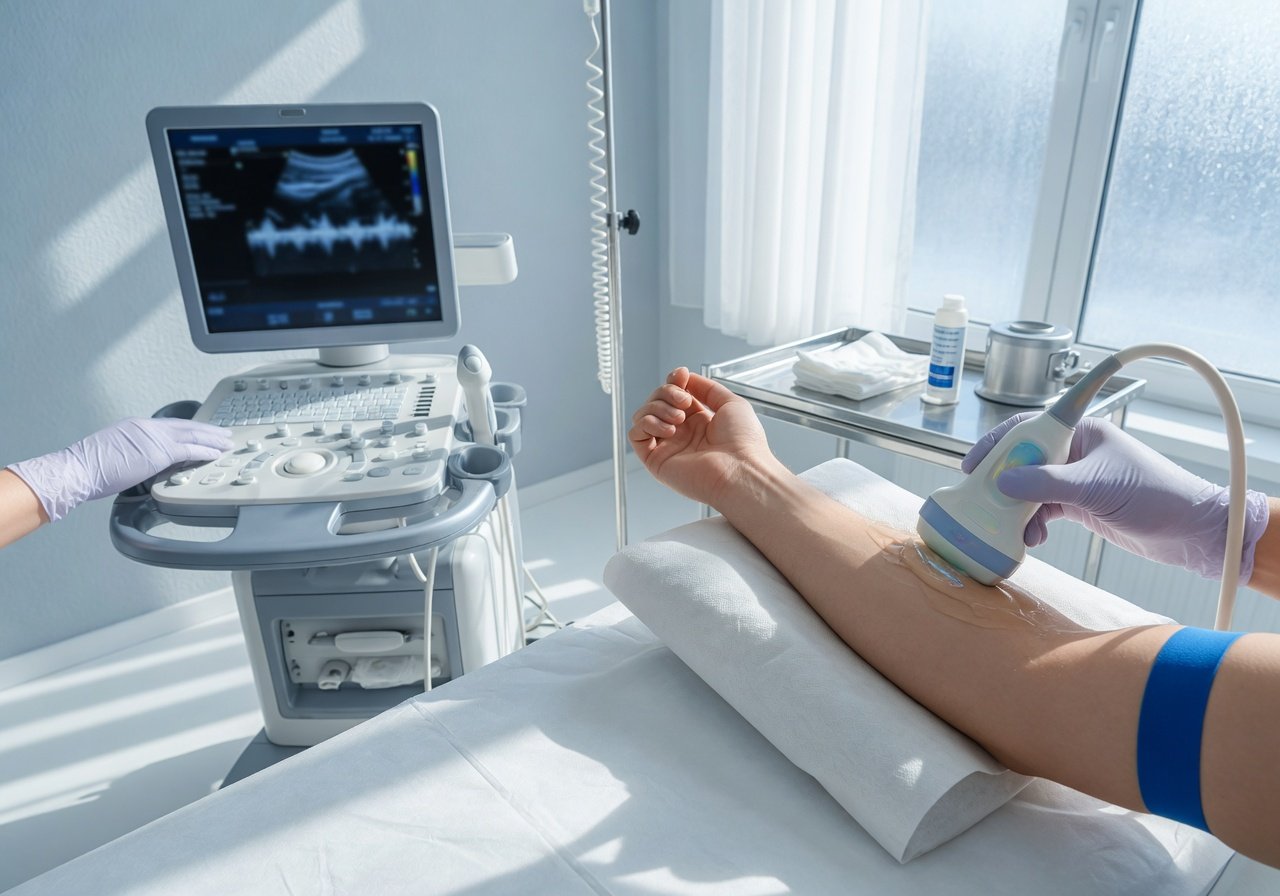
Dynamic duplex ultrasound is commonly discussed because it can assess blood flow while the technologist changes position or asks the patient to perform maneuvers. Depending on the question, this may include arm elevation, head turning, shoulder positioning, breath changes, standing, or other symptom-provoking positions.
Ultrasound can sometimes show whether flow becomes faster, slower, reversed, interrupted, or more pulsatile or phasic during a maneuver. However, ultrasound also has limits. It depends on the protocol, the technologist’s experience, body habitus, bowel gas, overlying bone, and whether the correct position reproduces symptoms.
Dynamic CTA, CTV, MRA, and MRV
Some centers perform CT or MRI angiography or venography with specific positioning. For thoracic outlet evaluation, this may include arms down and arms raised. For abdominal compression questions, radiologists may use multiplanar measurements and assess related organs, veins, and collateral pathways. For pelvic venous disorders, multiphase MRV or venography may be used to evaluate reflux and drainage patterns.
The key is that the imaging protocol must match the clinical question. A beautifully performed neutral scan may be excellent for detecting a clot or mass, but not designed to prove or disprove a position-dependent problem.
Common phrases in reports and what they may mean
- Patent: The vessel appears open on the images reviewed.
- No definite thrombus: No clear clot is seen, though very small or subtle clot may depend on image quality and protocol.
- No high-grade stenosis: No severe narrowing is seen in the imaged position.
- Collateral veins: Alternate venous pathways that may develop when usual drainage is narrowed or overloaded.
- Limited by contrast timing or artifact: The scan may not show the vessel as clearly as desired.
- Dynamic compression not excluded: The scan did not fully test the positions or conditions that might trigger narrowing.
Questions patients often ask after a reassuring scan
If my vessel is open, why do I still have symptoms?
Symptoms can come from many causes, including vascular, nerve, muscle, spine, gastrointestinal, gynecologic, or autonomic factors. An open vessel on static imaging is useful information, but it may not explain symptoms that occur only with movement, posture, exertion, meals, or prolonged standing.
Does phasic blood flow mean everything is normal?
Phasic blood flow often suggests that a vein is open and responding to normal pressure changes. That can be reassuring, especially when checking a stent for patency. It does not always answer every question about reflux, intermittent compression, pelvic venous pathways, or symptoms in a different position.
Can several compression syndromes occur together?
Some patients are evaluated for more than one compression pattern, especially when symptoms involve the neck, arms, abdomen, pelvis, or legs. Medical literature has also discussed overlap between vascular compression syndromes and autonomic symptoms in selected patients. This does not mean every symptom is caused by compression, but it supports careful, whole-person review rather than looking at one vessel in isolation.
How to prepare for a specialist visit
It can help to bring the official reports, images on disc or electronic portal access, prior studies, procedure notes for stents or coils, and a short symptom diary. Note what triggers symptoms: arm position, head turning, standing, eating, exercise, menstrual cycle, coughing, or lying down. Also note what improves them.
Useful questions may include:
- Was my scan neutral or dynamic?
- Were the positions that trigger my symptoms tested?
- Do I need Doppler ultrasound, dynamic CTA/CTV, MRA/MRV, or catheter venography?
- Are there signs of reflux, collateral veins, stent narrowing, or outflow obstruction?
- Which specialist is best for my pattern: vascular surgery, interventional radiology, thoracic outlet specialist, ENT, neurology, gastroenterology, or gynecology?
When to talk to your doctor
Talk to your doctor if your report says the vessels are open but your symptoms are persistent, positional, or worsening. Ask whether the imaging protocol matched the suspected compression syndrome and whether dynamic testing or specialist review is appropriate.
Seek urgent medical care for sudden arm or leg swelling, blue or pale color change, severe new pain, chest pain, shortness of breath, fainting, new weakness, stroke-like symptoms, heavy bleeding, vomiting, fever, or blood in the urine.
Get AI-powered analysis of your CT or MRI scan
Upload your DICOM files and receive a clear, patient-friendly report in minutes.
Analyze my scan