
How Long Does It Take to Get MRI Results? Typical Wait Times Explained
Most MRI results take 1 to 3 business days, but it can be hours or two weeks. See why, who reads your scan, and what you can do while you wait.

Have your own scan or report? Get a clear, plain-language explanation in minutes.
Short answer: for a routine outpatient MRI, most people get their results within 1 to 3 business days. The radiologist often finishes the written report within a day, and in many places it appears in your patient portal as soon as it is signed. Hearing from your own doctor usually takes longer, often several days to a week, and up to two weeks in some health systems. Emergency and inpatient MRIs are usually read within hours.
Typical MRI result times at a glance
| Situation | Report usually ready | When you typically hear |
|---|---|---|
| Emergency department | Within hours | Before you leave or are admitted |
| Hospital inpatient | Same day, often within hours | On the next ward round |
| Outpatient imaging center (US) | Same day to 3 business days | Patient portal on sign-off; doctor call or visit within about a week |
| Outpatient, public health system (UK, Canada, Australia) | A few days to 2 weeks | Usually via your referring doctor or at a follow-up appointment |
| Specialist reads (complex brain, cancer staging, cardiac) | Can take longer | At the specialist follow-up |
These are typical ranges, not guarantees. Your imaging center can tell you its own turnaround time, and it is worth asking before you leave.
What happens after your MRI scan
Knowing the steps explains most of the waiting:
- The scan is saved. Your MRI produces several image series (for example T1, T2 and FLAIR), often hundreds of slices in total. They go to the hospital's image archive within minutes.
- A radiologist reads it. A radiologist, a doctor specialised in imaging, scrolls through every series, compares it with any older scans and writes a report with findings and an impression (the summary).
- The report is signed. Once signed it is sent to the doctor who ordered the scan. In the US it is usually also released to your patient portal.
- Your doctor explains it. Your referring doctor puts the report in context with your symptoms and decides what happens next.
The technologist who ran the scanner is not allowed to interpret your images, so they cannot tell you the result on the day, even if you ask.
Why some MRI results take longer
- Radiologist workload. Imaging volumes are growing faster than the number of radiologists, and reading times have been rising in recent years.
- Comparison with older scans. If you had an MRI elsewhere, the radiologist may wait for those images to compare. Bringing them helps.
- Subspecialty reading. Brain, prostate, breast and cardiac MRIs are often sent to a radiologist with specific training, which can add a day or two.
- Weekends and holidays. Routine scans done on a Friday afternoon are often read the next business day.
- Your doctor's schedule. The report may be ready long before your doctor has time to call or see you.
Can you get MRI results the same day?
Sometimes. Emergency scans are read immediately, and some outpatient centers sign routine reports within a few hours. In the US, a signed report is usually released to your patient portal (for example MyChart) right away, so you may see it on the evening of your scan. A few US states allow a short hold, typically around three days, on results that may show a serious diagnosis such as cancer, so that your doctor can talk to you first.
Seeing your MRI results in MyChart before your doctor calls
Since 2021, US health providers must give patients electronic access to their results without blanket delays. Studies show that most patients now open their results before any clinician has contacted them. That is useful, but radiology reports are written for doctors. Words like unremarkable, signal abnormality or "clinical correlation recommended" can be hard to read, and an unfamiliar phrase can sound worse than it is.
If you see your report before your appointment:
- Read the impression section first. It is the radiologist's summary.
- Write down every term you do not understand and ask about it at your appointment.
- Remember that many findings, such as small disc bulges or minor age-related changes, are common in people without symptoms.
Is "no news" good news?
Not always. Urgent findings are usually phoned to your doctor straight away, so a serious result rarely sits unnoticed. But a missed call, a wrong phone number or a busy clinic can delay a normal result too. If you have heard nothing a week after a routine MRI, call the office that ordered the scan and ask whether the report has arrived.
When to call your doctor sooner
Do not wait for results if your symptoms get worse. Seek care promptly for new weakness or numbness, loss of bladder or bowel control, a sudden severe headache, confusion, trouble speaking, or a high fever after a contrast injection. Your MRI report never replaces medical attention for new or worsening symptoms.
What you can do while you wait
You are entitled to a copy of your images. Many imaging centers give you a CD, a USB stick or a download link from their patient portal, usually on the day of the scan. In the US, the HIPAA right of access covers your images as well as the report.
With those files you can look at your scan yourself in a free DICOM viewer, or upload it for an AI analysis of your MRI. You get a plain-language explanation of what the images show in a few minutes, and the analysis of your first image series is free. If your report is already available, you can add it as a PDF and ask questions about the wording. Not sure where the files are on the disc? Our DICOM upload guide shows you step by step.
An AI analysis does not replace your radiologist or your doctor. Its purpose is to help you understand your scan and prepare better questions for the conversation that decides your treatment.
Upload your MRI and get a plain-language analysis in minutes →
Frequently asked questions
How long do brain MRI results take?
Usually the same as other MRIs: 1 to 3 business days for a routine outpatient scan, within hours in an emergency. Brain scans are often read by a neuroradiologist, which can add a day.
How long do knee or back MRI results take?
Musculoskeletal MRIs are common and usually reported within 1 to 3 business days. You often discuss them at your next orthopedic or physiotherapy visit.
How long do breast MRI results take?
Typically a few days. Breast MRIs are read by a breast imaging specialist and compared with mammograms or earlier MRIs, and the report includes a BI-RADS category that guides the next step.
Can the MRI technician tell me my results?
No. Technologists operate the scanner but are not permitted to interpret images. Only the radiologist's signed report counts as the result.
Will the radiologist call me?
Usually not. The radiologist sends the report to your referring doctor, who discusses it with you. If something urgent is found, the radiologist contacts your doctor directly.
Why is my MRI result not in my patient portal yet?
Either the radiologist has not signed the report yet, or your provider is using a short state-permitted hold for sensitive results. Ask the imaging center whether the report has been signed.
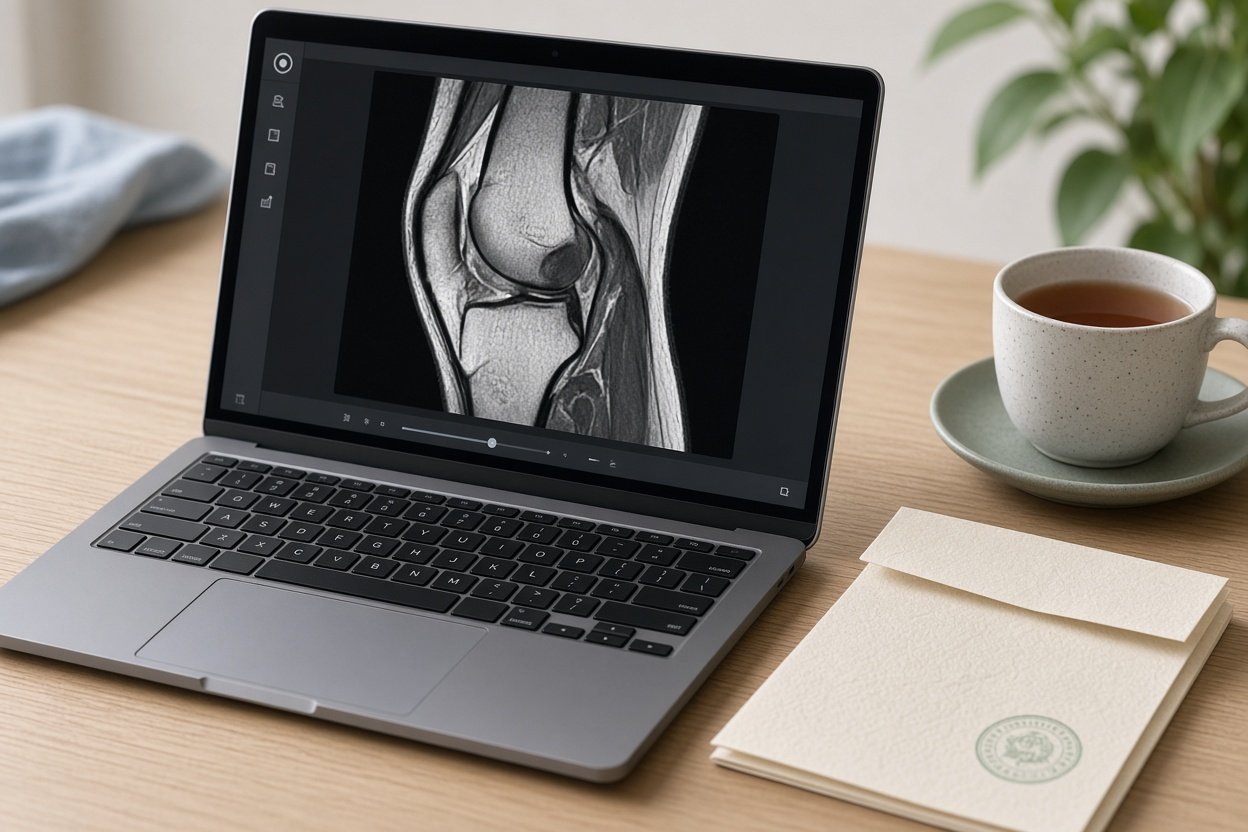
Get AI-powered analysis of your CT or MRI scan
Upload your DICOM files and receive a clear, patient-friendly report in minutes.
Analyze my scan